
The approach begins by identifying and defining the business problem AI is intended to solve, then validating whether AI is the right solution.
Business data is often distributed and disparate, and organizing and defining data for AI implementation can improve the quality and usefulness of AI deployment. Clear, well-structured data enables more accurate AI insights and more precise agent actions.
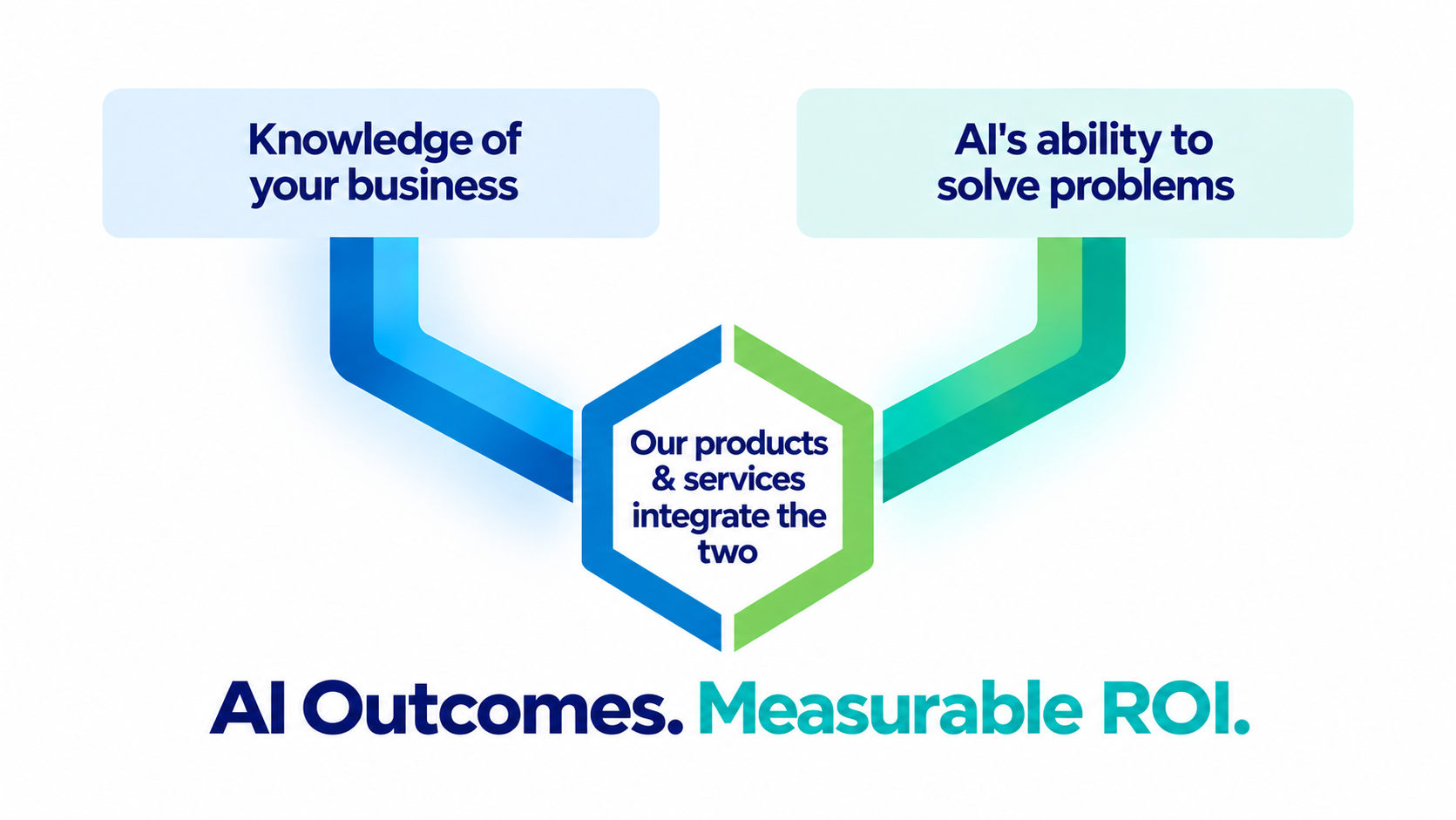










Organizations have invested in AI, yet not seen the intended results.
Businesses run on controlled data that AI models were not given access to and never taught to understand. The work is to define the business in the data so that AI can reason about it, then redesign the workflow for AI-enabled practice — so that the benefit can reach P&L.
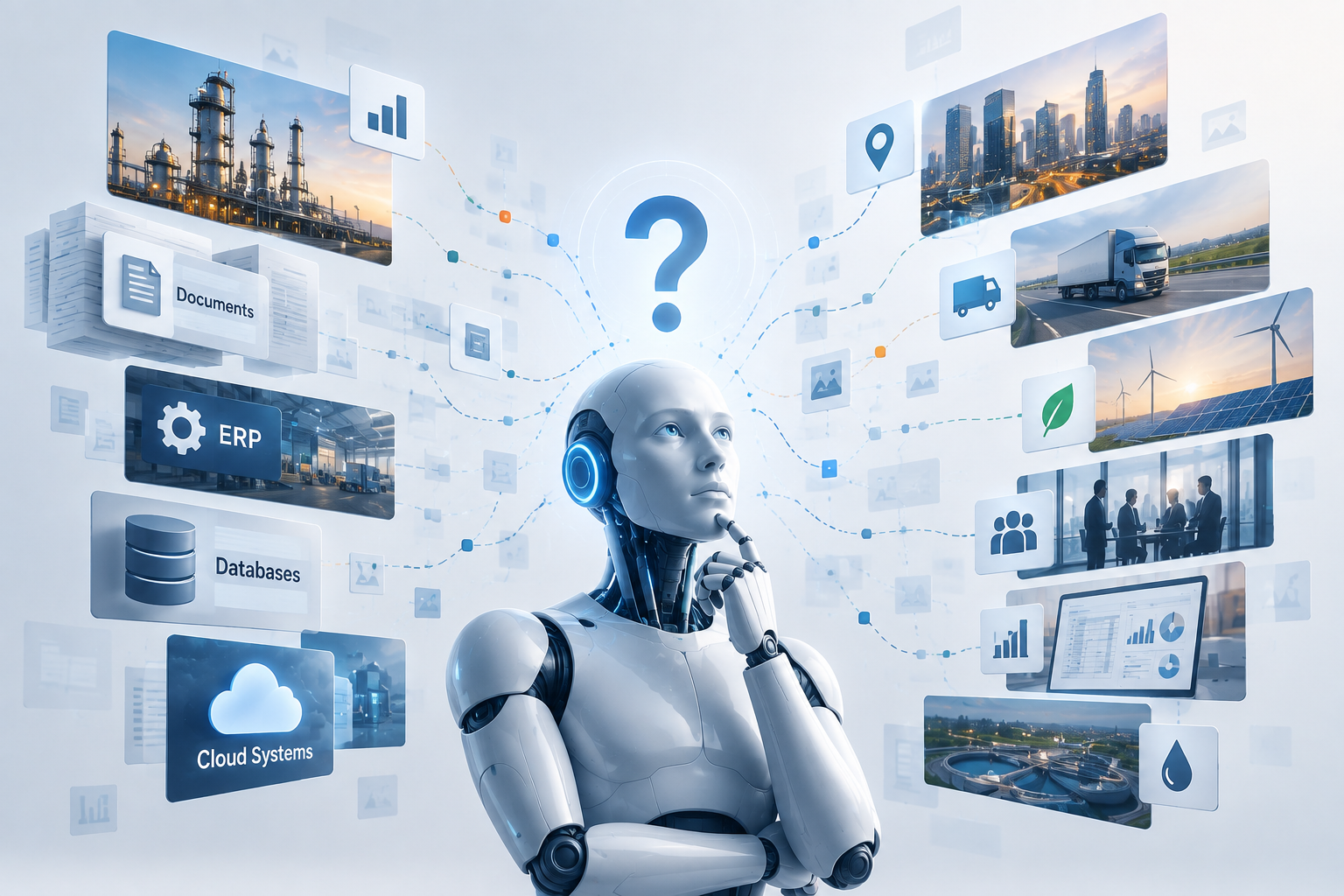
An AI model can answer a question — but it cannot automatically know which data definition the business uses, which rule takes precedence, how systems relate to each other, what exceptions matter, or what actions make sense in the operating context.
Industry subject matter expertise & other knowledge must be built into the data before the model ever sees it.
Data definitions that reflect the way the business actually operates.
How systems, records and operating entities relate to one another.
Rules that govern interpretation and the order in which they apply.
Conditions and exceptions that affect decisions and actions.
AI value is reflected in what changes in the operating environment.
No report request and no waiting on the data team for every question.
AI already understands the context behind the question.
Reduced exposure to surprise bills and runaway token spend.
AI becomes part of how work gets done, not another dashboard to check.
The data foundation supports current and future AI models and use cases.
The approach starts with problem definition and progresses through 4 well-defined steps.
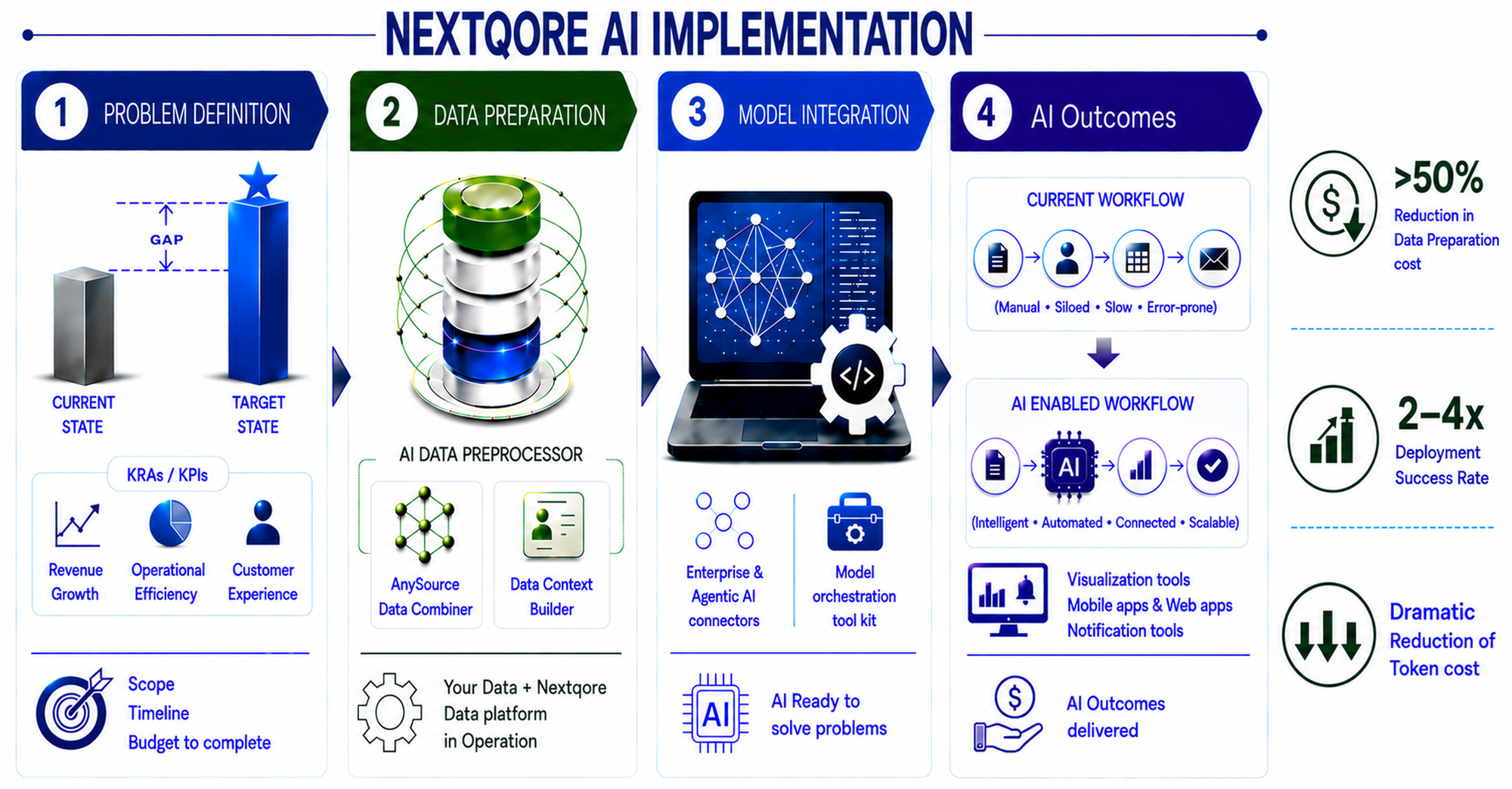
Start with the business result, not the technology. Scope the implementation around a specific, measurable outcome so success and commercial scope are clear.
Connect business data across systems, documents, spreadsheets, emails, sensors and processes. Clean, validate, structure and enrich data with business rules, terminology and operating context.
Integrate the right frontier or sovereign model for the job. With business logic in the data layer, models can be changed without rebuilding the foundation.
Deploy the AI-enabled workflow into operations so AI changes how work gets done and delivers the intended business outcome.
The implementation is measured by what changes in the operating environment.
Scope, timeline and commercial terms are agreed around specific milestones — not open-ended effort. Commitments are defined before work begins.
AI built on properly prepared, business-contextualized data is designed for production use — reducing the gap between an answer that requires double-checking and one that can support action.
AI is not a separate dashboard or chatbot. It is embedded into daily operations, supporting faster decisions and higher-value work.
The platform continues after go-live. Subsequent AI use cases can build on the foundation already established, supporting reuse across implementations.
The approach covers problem definition, data preparation, AI build, workflow implementation and platform operation. This reduces the need to coordinate separate strategy, integration and technology vendors.
A connected implementation model brings business problem definition, data preparation, AI integration and operational outcomes into one delivery approach.
The service model connects the business problem to the operating result, with each stage building on the previous one.
The business result defines the scope of work, the data required and the AI capability to be integrated.
AI becomes part of the workflow so the value is realized through day-to-day operations.
Every implementation runs on the Nextqore AI Data platform rather than being stitched together from third-party tools. This supports consistency, cost control, and accuracy at a fixed price. The platform is powered by the AI Data Preprocessor, which operates through two products — the AnySource Data Combiner and the Data Context Builder. Together, they prepare data for AI implementation.
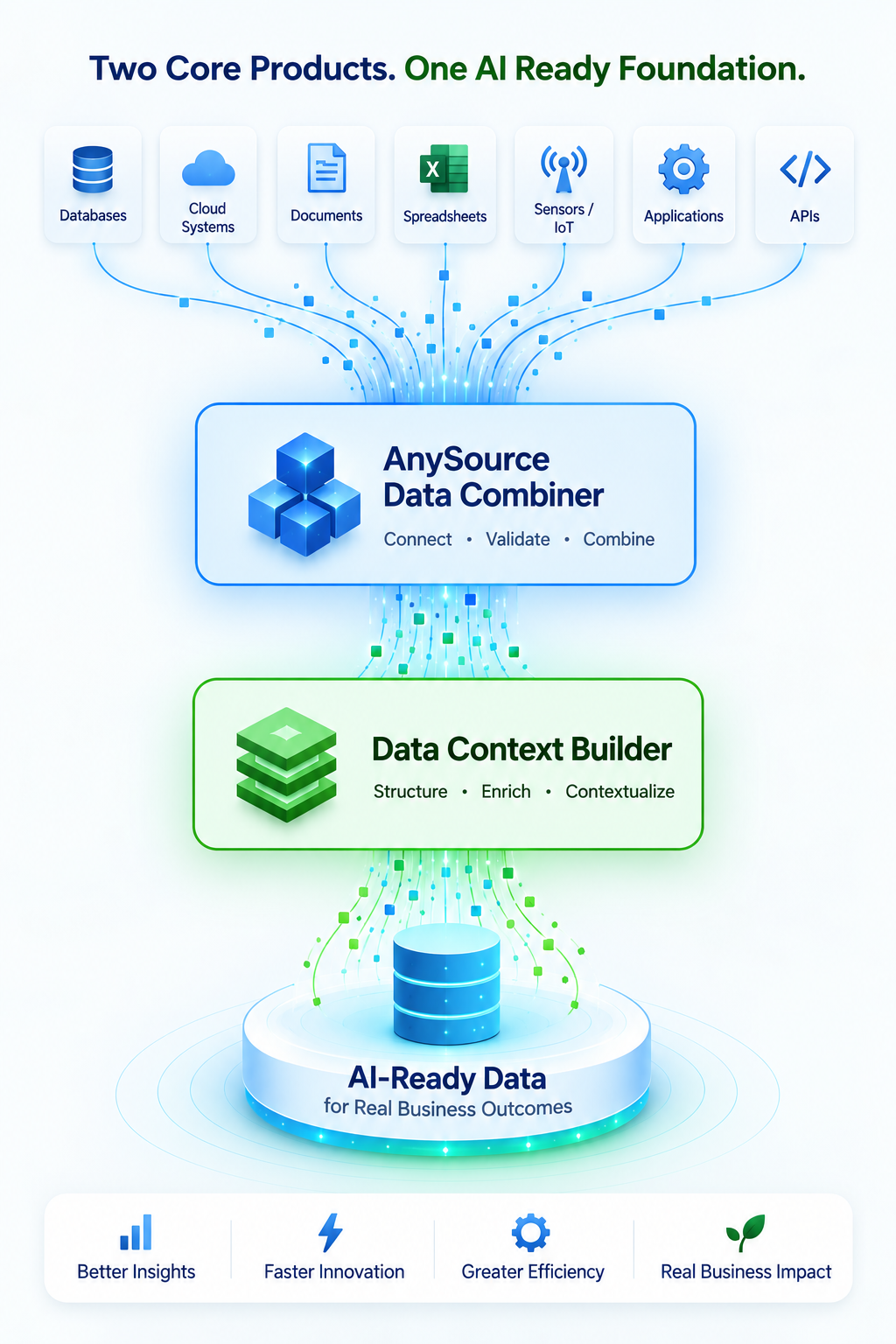
Connects varied business data sources, validates and combines data into a structured stream.
Enriches structured data with business vocabulary, rules and operational context.
Integrates the right frontier or sovereign model for the job while keeping business logic in the data layer.
The data foundation remains current as AI capabilities evolve, supporting future implementations without rebuilding the business context each time.
of AI projects will be abandoned through 2026 for lack of AI ready data — Gartner
of enterprise GenAI pilots show no measurable P&L impact — MIT, Project NANDA (2025)
of AI projects fail — roughly twice the failure rate of non-AI IT projects — RAND Corporation (2024)
of organizations lack the data management practices AI requires — Gartner
of Generative AI projects are abandoned after POC — Gartner
The takeaway: AI Outcomes depend on data prepared to address a well-defined problem.
Nextqore is an AI Data Preprocessor that gets enterprise data AI-ready before it reaches any AI model. It combines data from any source, enriching it with business context, and delivering structured, AI-ready data so AI projects deploy faster, perform more accurately, and cost significantly less to run.
Most enterprise AI projects fail not because of the AI model, but because of the data fed into it. Data is fragmented across IT applications, cloud storage, field devices, documents, video, and email — and it arrives without the business context AI models need to produce accurate, actionable outputs. Nextqore eliminates this bottleneck by preprocessing data before it reaches the AI model, solving the root cause rather than the symptom.
Nextqore is built for enterprise organisations actively deploying or scaling AI, analytics, and automation initiatives. It is most relevant for Chief Data Officers, Chief Technology Officers, Chief AI Officers, and the data engineering teams responsible for making AI projects work in production — across Energy Management, Telecom, Retail, Transportation and Logistics, Construction, and Infrastructure.
ETL tools move and transform data. Generic data pipelines transfer it. Nextqore does something fundamentally different — it adds business reasoning and operational context to data, making it genuinely AI-ready rather than just technically structured. The output is not clean data; it is contextualised, semantically enriched data that AI models can act on directly without additional preparation.
Nextqore connects to existing enterprise infrastructure without requiring changes to current systems. Customers typically achieve AI deployment timelines more than 20% faster than industry average because data preparation — which normally consumes 70 to 80 percent of AI project time — is handled systematically by the platform from day one.
Nextqore’s platform comprises two products that work in sequence. AnySource Data Combiner ingests and normalises data from any enterprise source — IT applications, cloud storage, field devices, documents, video, and email — into a unified structured stream. Data Context Builder then enriches that stream with business reasoning logic and operational semantics, producing AI-ready datasets that AI models can act on with accuracy and confidence.
.png)
.png)