

The Problem
Imagine Home’s interior design workflow depended on disconnected tools — designers worked manually across room measurement, product specification, client communication, and order processing with no unified digital platform. Connecting designers to clients and suppliers, capturing accurate spatial data, visualising furniture within actual room dimensions, and converting design decisions into executed orders required a fully integrated, AI-enabled platform built from the ground up.
The Solution
The AI Data Preprocessor was deployed to ingest, structure, and contextualise spatial, product, and transactional data across the Imagine Home platform. The AnySource Data Combiner unified data from LiDAR scans, product catalogues, supplier systems, and client interactions, while the Data Context Builder enriched spatial measurements with product dimensions, AR positioning data, and designer-client workflow context. This preprocessed output fed into NextqoreAI Analytics — powering an end-to-end iOS application that digitised the complete design-to-commerce lifecycle for interior designers, clients, and suppliers.
AnySource Data Combiner
LiDAR scan data captured via the iOS mobile app was ingested as field device input — generating simultaneous 3D models, 2D floor plans, measurement files and video outputs. Product catalogue data from multiple suppliers was ingested as document and IT application sources — including MSRP, wholesale pricing, dimensions and 3D model assets. All data streams were validated, normalised and structured into a unified pipeline connecting designers, clients and supplier inventory.

Data Context Builder
The combined spatial and product dataset was enriched with:
- Conditions — room dimensions, spatial constraints, and occupancy context applied to product placement recommendations
- Correlation — product dimensions and AR positioning data cross-referenced with LiDAR measurements to validate fit accuracy before proposal
- Computation — derived proposal values, line-item pricing, tax, discounts, and order totals calculated per project and per client
- OBS — Ontology Based Semantics establishing relationships between spaces, products, designers, clients, and supplier fulfilment entities — enabling AI to reason across the full design-to-purchase workflow
The Result
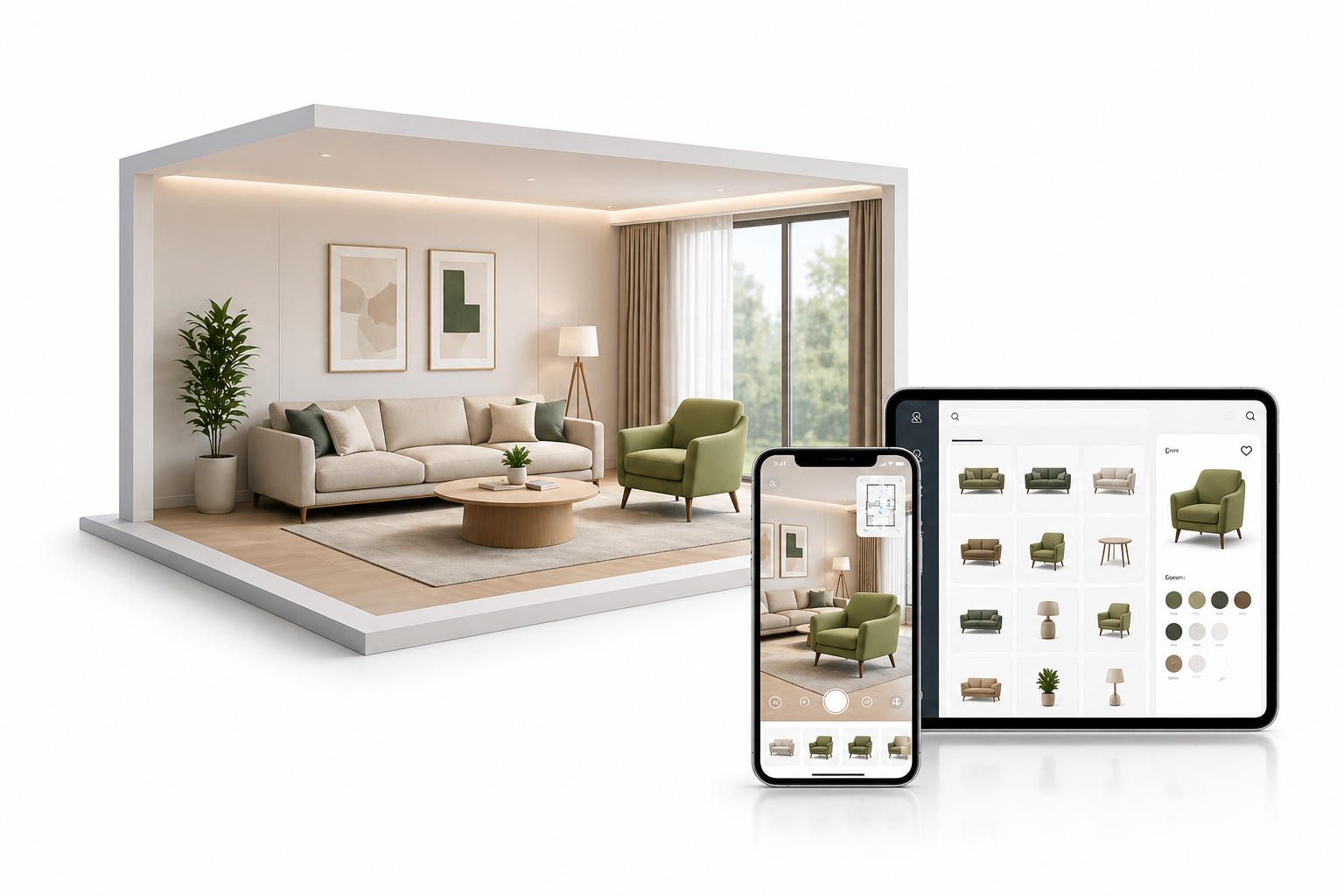
- LiDAR-powered room scanning — manual measurement processes replaced with automated spatial capture, generating accurate floor plans, 3D models, and measurement files on demand via iOS
- AR-enabled product visualisation — furniture and decorative items previewed in accurate dimensions within actual client spaces before selection, reducing specification errors and client change requests
- Designer-client connectivity — interior designers onboarded onto the platform, linked to clients via QR code, with proposal creation, line-item approval, and in-app payment managed end to end
- Supplier ecosystem integration — product catalogues from multiple suppliers structured and accessible to designers, with vendor-specific access controls, pricing visibility, and direct navigation to supplier platforms
- End-to-end commerce execution — Capture → Design → Specify → Approve → Pay → Fulfill workflow fully digitised, converting design intent into executed orders at scale with multi-channel notifications at every stage












.png)
.png)